
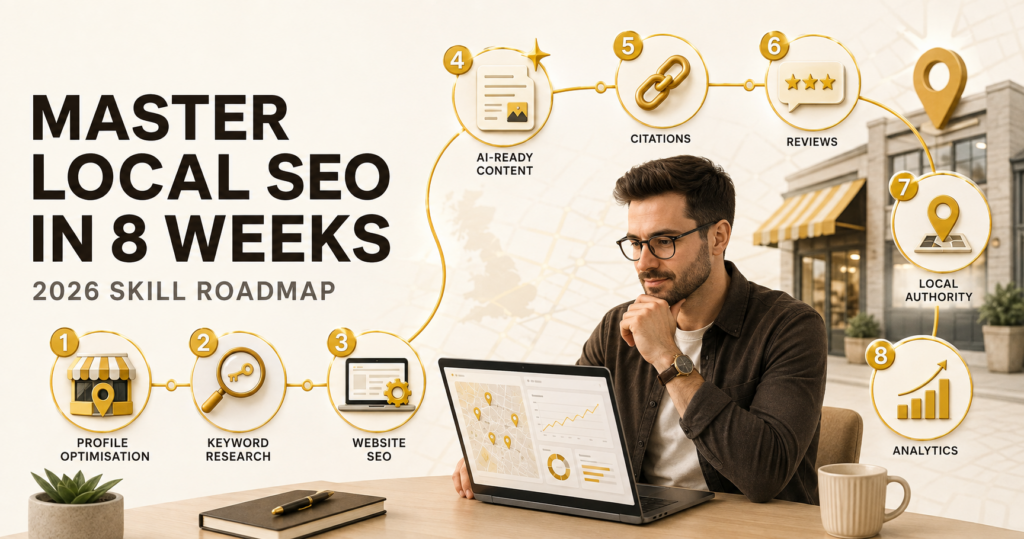
Master Local SEO in eight weeks with this practical 2026 roadmap. Learn how to optimise Google Business Profile, research local keywords, create AI-ready content, manage citations and reviews, earn trusted local links and measure results with GA4, Search Console and profile insights. Designed for marketing specialists and business owners, the guide turns modern Local SEO theory into weekly exercises that improve visibility, credibility and qualified customer enquiries without relying on outdated or risky ranking tactics.
Local search has changed. Customers no longer discover nearby businesses only through traditional Google results. They also use Google Maps, AI Overviews, AI-powered search experiences, review platforms, voice assistants and conversational tools to compare businesses and make decisions.
This eight-week Local SEO roadmap is designed for marketing specialists who want to develop practical skills rather than simply study theory. It combines Google Business Profile management, local keyword research, website optimisation, citations, reviews, authority building, analytics and AI-assisted research.
Each week includes focused learning, practical assignments, and measurable outcomes you can apply to a real or test business.
What Should You Learn Before Starting?
Choose one real local business, client account or carefully developed test business to use throughout the programme. Working with the same business will help you understand how individual Local SEO activities affect overall visibility.
Before beginning, record the following baseline information:
- Current Google Maps and organic search visibility
- Google Business Profile views and interactions
- Website impressions and clicks from Google Search Console
- Calls, bookings, enquiries and direction requests
- Number and quality of customer reviews
- Average review rating
- Accuracy of business information across major platforms
- Existing local backlinks and brand mentions
- Visibility for important service-and-location searches
Local rankings are influenced mainly by relevance, distance and prominence. Distance cannot always be changed, so your work should concentrate on strengthening relevance, credibility and local prominence. Google Business Profile guidance confirms these as the principal local-ranking considerations.
Week 1: Understand the Modern Local Search Environment
Days 1–2: Learn How Local Search Works
Start by understanding the difference between:
- Google Maps results
- The local pack
- Standard organic results
- Branded searches
- Service-and-location searches
- Near-me searches
- AI-generated search responses
- Navigation and discovery searches
Study how search results change according to the searcher’s location, query, device and intent.
Days 3–5: Audit a Google Business Profile
Review the selected business’s Google Business Profile and examine:
- Business name
- Primary and secondary categories
- Address or service area
- Phone number and website
- Opening hours and special hours
- Services and products
- Business description
- Appointment and booking links
- Photographs and videos
- Customer questions and answers
- Reviews and owner responses
Do not add keywords to the business name unless they form part of the genuine, real-world business name. Profile information should accurately represent the business rather than attempt to manipulate rankings.
Practical Exercise
Complete a Google Business Profile audit and prepare a prioritised list of corrections.
Weekly Review
Explain how relevance, distance and prominence affect the selected business. Identify five actions that could improve its local visibility without violating platform guidelines.
Week 2: Local Keyword Research and Search Intent
Days 1–2: Build a Local Search-Intent Map
Research how customers search for the business’s services. Go beyond simple phrases such as “service + city” and consider:
- Emergency or urgent searches
- Price and cost questions
- Best-provider searches
- Open-now searches
- Neighbourhood and landmark searches
- Service-area searches
- Problem-based questions
- Comparison and recommendation searches
- Branded and unbranded searches
AI-assisted tools can help generate seed questions and variations, but don’t treat them as a source of verified search volumes or actual customer demand.
Days 3–5: Validate and Group the Keywords
Use data from Google Search Console, Google Ads Keyword Planner, Google Trends, Google Business Profile performance and relevant third-party tools.
Group the findings by:
- Search intent
- Service
- Location
- Customer problem
- Stage of the buying journey
- Suitable destination page
Avoid creating a separate thin page for every minor keyword or nearby location. Several closely related searches can usually be addressed through one comprehensive, useful page.
Practical Exercise
Create a keyword-to-page map showing which existing page should target each keyword group and where a new page is genuinely required.
Weekly Review
Check whether every selected keyword has a clear user intent and a suitable landing page. Remove keywords chosen only because they appear to have high volume.
Week 3: Local Website and On-Page Optimisation
Days 1–2: Review Core Landing Pages
Audit the homepage, location pages and service pages. Examine:
- Page titles and meta descriptions
- Main headings and subheadings
- Service descriptions
- Location relevance
- Internal links
- Calls to action
- Contact details
- Opening hours
- Directions and parking information
- Accessibility information
- Embedded maps where useful
- Mobile usability
- Page speed
- Indexability and canonical tags
Location information should be genuinely helpful. Simply repeating city names throughout a page will not make it locally authoritative.
Days 3–5: Improve Entity and Business Clarity
Make it easy for customers and search systems to understand:
- What the business does
- Where it operates
- Who it serves
- How long it has operated
- Who is responsible for the service
- What qualifications or experience it possesses
- How customers can contact or visit it
- What distinguishes it from nearby alternatives
Add appropriate structured data, such as LocalBusiness, where it accurately represents visible information on the page. Structured data can support search understanding and rich-result eligibility, but it does not guarantee rankings or inclusion in AI-generated answers.
Practical Exercise
Optimise one important service or location page. Record the original version, changes made and metrics to monitor.
Weekly Review
Ask another marketer to review the page from a customer’s perspective. Can the person quickly understand the service, location, credibility and next step?
Week 4: Local Content and AI Search Readiness
Days 1–2: Identify Locally Valuable Topics
Create content that reflects genuine customer needs and local knowledge. Suitable topics may include:
- Local service costs
- Area-specific regulations
- Seasonal problems
- Local events connected with the business
- Neighbourhood guides
- Frequently asked customer questions
- Local case studies
- Service comparisons
- Original statistics or observations
- Advice based on first-hand experience
Generic AI-generated articles that could apply to any city provide little local value.
Days 3–5: Create Evidence-Based Content
Publish one locally focused article or guide containing original input from the business. This might include:
- A quotation from a practitioner
- Photographs from a completed project
- First-hand observations
- A customer case study
- Locally collected data
- A clearly explained method
- Specific examples from the service area
Google states that the same core SEO principles continue to apply to AI Overviews and AI Mode. Pages should be indexable, useful and eligible to appear with a search snippet; there is no special AI schema or mandatory AI optimisation file. Google’s AI search guidance also emphasises useful, original content over AI-specific tricks.
Practical Exercise
Use AI to help organise research, identify missing questions or improve the content outline. Have a knowledgeable human verify every factual statement and add first-hand expertise before publication.
Weekly Review
Assess whether the finished content contributes something original. If an AI system could recreate the entire article without access to the business, add more first-hand evidence and local specificity.
Week 5: Citations, Listings and Local Authority
Days 1–2: Audit Business Information
Review the business’s name, address, telephone number, website and opening hours across its most important platforms.
Depending on the business and market, these may include:
- Google Business Profile
- Apple Business Connect
- Bing Places
- Yelp
- Reputable UK business directories
- Professional associations
- Local chambers of commerce
- Trade-specific platforms
- Relevant booking or review platforms
Citation value comes from accuracy, relevance and platform quality—not from submitting the business to the largest possible number of directories.
Days 3–5: Correct and Strengthen Important Listings
Fix duplicate, incomplete and inconsistent listings. Add accurate descriptions, categories, images and website links where the platform permits them.
For businesses targeting British customers, carefully selected UK local citations can help establish consistent business information across relevant discovery platforms. Businesses that need greater certainty about publication may also consider guaranteed directory-listing services, provided the directories are legitimate and relevant.
Practical Exercise
Create a citation tracker showing:
- Platform
- Listing URL
- Login or ownership status
- Business details
- Errors found
- Corrections requested
- Current status
- Last review date
Weekly Review
Verify the most important listings manually. Do not assume that a submission has been published or indexed merely because it was sent.
Week 6: Reviews, Reputation and Customer Experience
Days 1–2: Build a Compliant Review Process
Create a repeatable process for requesting honest reviews after genuine customer interactions. Review requests may be delivered through:
- SMS
- Receipts
- Follow-up messages
- QR codes
- Booking or customer-management systems
Do not offer rewards for positive reviews, selectively request reviews only from satisfied customers or ask employees to publish misleading feedback.
Days 3–5: Develop a Response Framework
Prepare flexible response principles for:
- Positive reviews
- Neutral reviews
- Genuine complaints
- Reviews lacking sufficient detail
- Suspected fake reviews
- Complaints requiring offline resolution
Responses should sound human and address the actual customer experience. Repeating the same keyword-heavy response underneath every review looks artificial and provides little value.
Practical Exercise
Draft responses to ten realistic review scenarios and create an escalation process for serious complaints.
Weekly Review
Measure review velocity, average rating, response time and recurring themes. Treat reviews as customer-research data, not merely as a ranking signal.
Week 7: Local Links, Mentions and Community Authority
Days 1–2: Identify Legitimate Local Relationships
Look for opportunities arising from real business activity, such as:
- Local sponsorships
- Chamber memberships
- Community events
- Supplier relationships
- Professional associations
- Local journalism
- Expert commentary
- Charitable work
- Research or local data
- Partnerships with complementary businesses
Avoid bulk link exchanges, paid-link schemes and irrelevant guest-post campaigns designed only to manipulate rankings.
Days 3–5: Create a Local Outreach Campaign
Develop a useful story, resource or contribution before contacting publishers. A strong pitch explains why the information matters to the publisher’s audience rather than simply requesting a backlink.
Practical Exercise
Prepare a prospect list of 20 locally or professionally relevant organisations. Personalise five outreach messages based on a genuine connection or contribution.
Weekly Review
Evaluate success using more than the number of links acquired. Consider:
- Publication relevance
- Referral traffic
- Brand mentions
- Community relationships
- Enquiries generated
- Quality of the referring website
Week 8: Measurement, Experimentation and AI-Assisted Workflows
Days 1–2: Build a Local SEO Dashboard
Combine data from Google Business Profile, Google Search Console and GA4. Useful measurements include:
- Search impressions
- Organic clicks
- Search queries
- Calls
- Direction requests
- Website visits
- Bookings
- Form submissions
- Conversion rate
- Branded versus non-branded visibility
- Performance of service and location pages
- Review growth
- Referral traffic from local platforms
Rank tracking can provide directional information, but local rankings vary by location and device. Do not treat a single manually checked position as a complete performance measure.
Days 3–4: Compare Results With the Baseline
Review what changed during the programme. Separate actions from outcomes and avoid claiming causation without enough evidence.
For example, a rise in calls may coincide with profile improvements, but seasonal demand, advertising or a competitor’s closure may also have contributed.
Day 5: Create a 90-Day Local SEO Plan
Prepare a forward plan covering:
- Profile maintenance
- New review acquisition
- Citation corrections
- Content updates
- Local authority opportunities
- Technical improvements
- Conversion tracking
- Monthly reporting
- Controlled experiments
AI can help categorise reviews, cluster queries, summarise performance data, and draft initial content structures. Human oversight remains essential for accuracy, business context, customer communication and strategic decisions.
Final Exercise
Present a short Local SEO case study containing:
- The original problem
- Baseline measurements
- Actions completed
- Results observed
- Limitations of the data
- Lessons learned
- Recommended next actions
How Has AI Changed Local SEO?
AI has expanded the number and complexity of questions people ask, but it has not removed the need for sound Local SEO.
A local business still needs:
- Accurate and complete business information
- A well-managed Google Business Profile
- Helpful service and location pages
- Authentic reviews
- Consistent details across important platforms
- Original local knowledge
- Crawlable and indexable website content
- Clear evidence of experience and credibility
This means businesses should optimise for both discovery and selection. Appearing in a result is only the first step. The business must also give customers—and the systems assisting them—enough reliable information to choose it confidently.
Google advises publishers to continue applying foundational SEO practices to generative search and to focus on valuable, original content rather than unsupported AEO or GEO tricks. It specifically warns against scaled, low-value content, artificial mentions and unnecessary AI-only markup. Google’s generative AI optimisation guide provides the current official position.
Common Mistakes to Avoid
- Using an outdated or inaccurate business name
- Choosing irrelevant Google Business Profile categories
- Creating thin pages for every nearby town
- Publishing generic AI-generated local content
- Buying large volumes of low-quality citations
- Using fake addresses or virtual offices to target more locations
- Exchanging links solely to influence rankings
- Incentivising positive reviews
- Copying the same review response repeatedly
- Reporting rankings without calls, leads or conversions
- Treating AI visibility as a replacement for conventional SEO
- Expecting immediate results from isolated changes
Frequently Asked Questions (FAQ)
What is Local SEO and why is it important for businesses?
Local SEO is the process of improving a business’s visibility in location-based Google Search and Google Maps results. It helps nearby customers discover services, compare reviews, get directions, and make contact, making it especially valuable for shops, professional firms, tradespeople, restaurants, and service-area businesses.
How long does it take to learn Local SEO?
A marketing specialist can build a practical Local SEO foundation in approximately eight weeks through structured study and hands-on exercises. Developing advanced expertise takes longer because Google Business Profile management, local content, citation building, review acquisition, technical SEO and performance analysis require ongoing testing across different businesses and locations.
What are the main Local SEO ranking factors?
Google primarily evaluates relevance, distance and prominence when producing local search results. Businesses can strengthen relevance through accurate categories and service information, while reviews, authoritative local links, citations and overall website reputation support prominence; distance depends largely on the searcher’s location and cannot be directly controlled through optimisation.
How does Google Business Profile help with Local SEO?
Google Business Profile helps a business appear across Google Search and Maps with its location, services, opening hours, photographs, reviews and contact options. Keeping the profile complete, accurate, and active helps Google understand the business and lets potential customers call, visit the website, request directions, or make bookings.
Are local citations still important for Local SEO in 2026?
Local citations remain useful when they place accurate business information on reputable, relevant platforms. Consistent business names, addresses, telephone numbers and website details can reinforce trust and help customers discover the business, but mass submission to low-quality directories is less valuable than maintaining authoritative local, industry and country-specific listings.
How has AI search changed Local SEO?
AI search has expanded how customers research, compare and select local businesses, but it has not replaced traditional Local SEO. Businesses still need crawlable websites, accurate profiles, authentic reviews and helpful content, while original local expertise, clear business information and verifiable evidence improve the likelihood of being understood and referenced in AI-generated answers.
Which metrics should businesses track for Local SEO?
Businesses should track local search impressions, website clicks, telephone calls, direction requests, bookings, form submissions, review growth and conversions. Google Search Console, GA4, and Google Business Profile performance data provide a stronger view of results than rankings alone because local positions naturally vary by the searcher’s location, device, and query.
Conclusion: Build Local Visibility That Produces Business Results
This eight-week roadmap develops practical Local SEO skills across profile management, keyword research, website optimisation, local content, citations, reviews, community authority and performance measurement.
The aim is not merely to improve a few search positions. A successful local strategy should help the right customers discover the business, understand its services, trust its reputation and take a measurable action.
Local SEO is an ongoing discipline. Business information changes, competitors improve, customer questions evolve and search interfaces continue to develop. Maintain the profile, review performance regularly, publish useful local information and improve the customer journey based on real evidence.
For businesses managing citations at scale, a structured local citation service can support the process. It should, however, complement accurate profile management, strong local content, genuine reviews and credible community relationships—not replace them.