
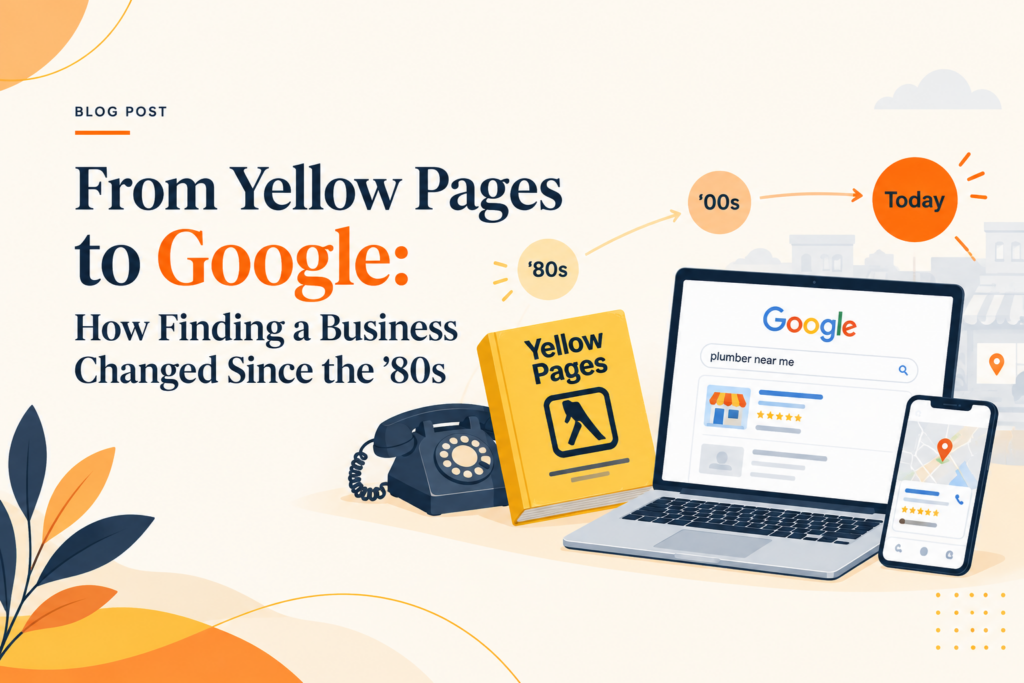
In the 1980s, finding a plumber meant pulling a heavy yellow book off the shelf and flipping to “P.” Today, you ask your phone and, in seconds, get a map, opening hours, reviews, and often a direct answer from an AI assistant.
That shift did more than save time. It completely rewrote the rules for how businesses get discovered. Being listed first used to depend on your name and ad size. Now it depends on relevance, reputation, and how clearly search engines and AI tools understand who you are.
This article walks through the history of local search, decade by decade, from printed directories to AI-generated answers. Along the way, you will see what each era teaches about getting found today, and you will finish with a practical checklist you can act on.
Local Search History at a Glance
The journey from paper directories to AI answers spans more than a century. These milestones shaped how people find businesses today.
| Year | Milestone | Why it mattered |
|---|---|---|
| 2024 | Google rolls out AI Overviews in the US | AI-written summaries begin answering searches before users click any link |
| 2021 | Google My Business is renamed Google Business Profile | The free listing becomes central to appearing in local results |
| 2014 | Google My Business launches | Businesses gain one dashboard to manage their presence on Search and Maps |
| 2007 | Apple launches the iPhone | Mobile internet goes mainstream and searches start happening on the move |
| 2005 | Google Maps launches | Search results gain a visual, location-based layer |
| 2004 | Google Local launches and Yelp is founded | Online listings and customer reviews start to compete with print directories |
| 1998 | Google is founded | Ranking by relevance and links reshapes how people search the web |
| 1994 | Yahoo starts as a web directory | Early internet users browse websites by category, much like a phone book |
| 1982 | France rolls out Minitel nationally | Millions of homes get an electronic phone directory via a screen terminal |
| 1886 | Reuben H. Donnelley publishes an early official Yellow Pages directory in Chicago | The classified business directory becomes a standard format |
| 1883 | A printer in Cheyenne, Wyoming, uses yellow paper for a directory | The story most often credited as the origin of the Yellow Pages name |
The 1980s: Phone Books, Operators, and Word of Mouth
In the 1980s, local search was physical. Most households kept a printed business directory near the phone, and it was often the first place people looked when they needed a service.
If the book did not help, people had a few other options:
- Directory assistance. Callers could dial an operator (411 in the US) and ask for a business by name.
- Recommendations. Friends, neighbours, and coworkers were the original review sites.
- Local media. Newspaper classifieds, radio spots, and community noticeboards filled the gaps.
How businesses competed in print
Visibility in a printed directory came down to two things: alphabetical order and ad size. That led to some creative tactics. Many companies chose names like “AAA Plumbing” or “A1 Auto Repair” simply to appear at the top of their category.
Bigger budgets bought bigger display ads, bold type, and better placement. A small shop with excellent service could easily be buried under a competitor that paid for a half-page ad.
There was another catch. Directories were usually printed once a year, so a new phone number or address might stay wrong for months.
A global view: France’s Minitel
Not every country waited for the web. France’s Minitel, rolled out nationally in the early 1980s, gave millions of homes a small screen terminal connected to the phone line. One of its most popular services was an electronic directory, an early glimpse of searching for businesses on a screen.
The 1990s: The Phone Book Moves Online
The early web borrowed heavily from the phone book. Yahoo began in 1994 as a hand-built directory of websites, organised into categories that people browsed rather than searched.
Directory publishers also launched online versions of their printed books. At first, these were little more than digital copies: the same listings and the same paid placements, just on a screen.
Early search engines changed the game by letting people type what they wanted. But results were often messy. Many engines relied heavily on the words on a page, which made them easy to manipulate by repeating keywords.
For businesses, the decade’s lesson was simple. Having a website was becoming a sign of credibility, even if few customers used it to find a local shop yet.
The 2000s: Google, Maps, and the Birth of Local SEO
Google, founded in 1998, ranked pages partly by the links pointing to them. That idea made results far more useful, and it shifted visibility away from who paid the most toward who seemed most relevant and trusted.
The real turning point for local businesses came in the mid-2000s:
- Google Local (2004) began connecting searches with nearby business listings.
- Google Maps (2005) added an interactive map, so people could see exactly where a business was.
- Yelp (2004) and similar platforms made customer reviews public and searchable.
These changes created what we now call local SEO. For the first time, a small business with accurate listings, a helpful website, and happy customers could outrank a much larger competitor.
It also introduced a new problem: inconsistent information. A business might have one address on its website, another on an old directory, and a third on a review site. Search engines began to treat consistent name, address, and phone number details, often shortened to NAP, as a signal of trust.
The 2010s: Smartphones, Reviews, and “Near Me”
The iPhone arrived in 2007, and over the following decade smartphones put search in everyone’s pocket. Local search stopped being something people did at a desk and became something they did on the street, often minutes before buying.
That changed search behaviour in a few important ways:
- Location became automatic. Phones could tell search engines where you were, so phrases like “coffee near me” returned results within walking distance.
- The map took centre stage. A short list of businesses shown on a map, often called the local pack, became the most valuable space for local results.
- Reviews became decision-makers. Star ratings and recent comments appeared right beside listings, shaping choices before anyone visited a website.
- Voice search arrived. Assistants such as Siri and Google Assistant let people ask out loud, using longer, more conversational questions.
Google launched Google My Business in 2014, giving owners one place to manage their hours, photos, posts, and review replies. For many local businesses, that free profile became more important than their own homepage.
The 2020s: AI Search and Answer Engines
The latest shift is from link lists to direct answers. Google renamed its listing service Google Business Profile in 2021, and in 2024 it began showing AI Overviews, AI-written summaries that appear above traditional results in many searches.
At the same time, AI assistants such as ChatGPT, Gemini, Perplexity, and Claude can search the web and recommend businesses in conversation. Someone might ask, “What’s a good family-friendly Italian restaurant downtown that takes reservations?” and get a short, reasoned shortlist instead of ten blue links.
What this means for discovery
AI tools build their answers from information they can find and trust across the web. That typically includes:
- Business listings and maps data
- Your own website, especially clear service and location pages
- Reviews and ratings on established platforms
- Mentions in news articles, local guides, and industry directories
This is where newer disciplines come in. Generative Engine Optimization (GEO) and Answer Engine Optimization (AEO) focus on making a business easy for AI systems to understand, verify, and recommend. They build on SEO rather than replacing it.
The exact way each AI tool selects sources is not fully public and changes often. The safest approach is to be accurate, consistent, and genuinely well regarded wherever your business appears.
What Changed, and What Stayed the Same
The tools are unrecognisable, but the customer’s goal has not changed: find someone nearby who can be trusted to do the job well.
| 1980s | Today | |
|---|---|---|
| Where people look | Printed directory, operator, friends | Search engines, maps, review sites, AI assistants |
| What decides visibility | Alphabetical order and ad size | Relevance, distance, reputation, and clear information |
| How often information updates | Usually once a year | Instantly, by the business or by customers |
| Source of trust | Personal recommendations | Reviews, ratings, and mentions across the web |
| Cost of being found | Mostly paid placement | A free profile plus effort, with paid ads optional |
The biggest difference is who holds the power. In the print era, money bought attention. Today, accuracy and reputation matter far more, which gives smaller businesses a real chance to compete.
What stayed the same is the value of word of mouth. Online reviews and AI recommendations are, in many ways, word of mouth at a global scale.
How to Get Your Business Found Today: A Practical Checklist
History offers a clear lesson: the businesses that win are the ones that are easiest to find and easiest to trust. Use this checklist to cover the essentials across search, maps, and AI tools.
1. Claim and complete your business profiles
- Claim your Google Business Profile, plus Apple Business Connect and Bing Places.
- Fill in every relevant field: categories, hours, services, service areas, and photos.
- Keep holiday hours and temporary changes current.
2. Keep your details consistent everywhere
- Use the same business name, address, and phone number on your website, profiles, and directories.
- Update old listings when you move or change numbers.
- Remove or correct duplicate listings.
3. Build a website that answers real questions
- Create a clear page for each main service and each location you serve.
- Make sure your site loads quickly and works well on mobile.
- Add structured data, such as LocalBusiness schema, so search engines can read key details easily.
- Include a helpful FAQ section written in plain language.
4. Earn and manage reviews
- Ask happy customers for reviews as part of your normal process.
- Reply to reviews, both positive and negative, politely and promptly.
- Never buy fake reviews. It breaks platform rules and damages trust.
5. Get mentioned in trusted places
- Seek coverage in local news, community sites, and industry directories.
- Partner with local organisations, events, or charities.
- Publish useful content that others want to reference.
6. Prepare for AI search
- Describe what you do, where, and for whom in clear, specific language.
- Keep information identical across every platform, so AI tools can verify it.
- Periodically ask AI assistants about your category and location to see how your business appears.
Frequently Asked Questions
Do printed Yellow Pages still exist?
In some regions, printed business directories are still produced, though in far smaller numbers than in the past, and many publishers have shifted to digital. Availability varies by country and provider, so check with your local publisher.
What is local SEO?
Local SEO is the practice of improving a business’s visibility in location-based searches, such as “dentist near me.” It covers business profiles, consistent contact details, reviews, local content, and website optimization.
How is AI search different from traditional search?
Traditional search shows a ranked list of links for you to explore. AI search often summarises information and recommends options directly, drawing on multiple sources at once. The user may never visit your website, so how your business is described across the web matters more.
What are GEO and AEO?
Generative Engine Optimization (GEO) and Answer Engine Optimization (AEO) are approaches that help businesses appear accurately in AI-generated answers. They rely on clear, consistent, trustworthy information and work alongside traditional SEO.
Is a Google Business Profile free?
Yes. Creating and managing a Google Business Profile is free. Google offers paid advertising separately, but it is optional.
Final Thoughts: From the Bookshelf to the AI Assistant
In four decades, local search has moved from a book on the shelf to an answer on a screen. Each step has rewarded the same qualities, just more: accuracy, relevance, and a good reputation.
The businesses that thrived in print were the ones customers could find. The ones thriving now are the ones search engines and AI tools can understand and confidently recommend. If your information is scattered, outdated, or thin, you risk being left out of the conversation entirely.
Megrisoft has been helping businesses adapt to changes in search since 1998. From local SEO and business listings to Generative Engine Optimization and AI search visibility, we help brands stay discoverable wherever their customers look next. If you want your business to show up in AI answers as well as on the map, contact our team.